
Highland Council Planning Objection Success
Description
Planning application for flatted development in Highland Council area refused February 2026
Location
Outcome
Planning Application Refused
Introduction
Residential developments within established neighbourhoods require careful consideration to ensure they integrate successfully with their surroundings and do not result in unacceptable impacts on neighbouring residents or the wider environment. While additional housing is an important component of Scotland’s planning system, proposals must still satisfy National Planning Framework 4 (NPF4), the Highland-wide Local Development Plan and other material planning considerations.
This case study explains how Planning Objections Scotland assisted neighbouring residents by preparing a comprehensive planning objection to a proposed development of twelve flats within an established residential area of Inverness.
To protect client confidentiality, identifying details have been removed. However, the planning issues, methodology and approach accurately reflect the work undertaken. The objection was subsequently updated following the submission of revised plans to ensure all new information was fully assessed.
The Proposal
The application sought planning permission for the erection of residential flats together with associated roads, parking, drainage infrastructure and landscaping on an undeveloped site within an established residential area.
Although the proposal would contribute towards housing delivery, the scale and form of development raised a number of planning issues requiring careful assessment. The application involved a relatively intensive form of development on a constrained site, requiring significant consideration of neighbouring amenity, access arrangements, landscaping, drainage, biodiversity and design quality.
Our clients instructed Planning Objections Scotland to undertake an independent review of the planning application and determine whether the proposal complied with National Planning Framework 4 (NPF4), the Highland-wide Local Development Plan and other material planning considerations.
Applying the P.O.S. Intervene Method
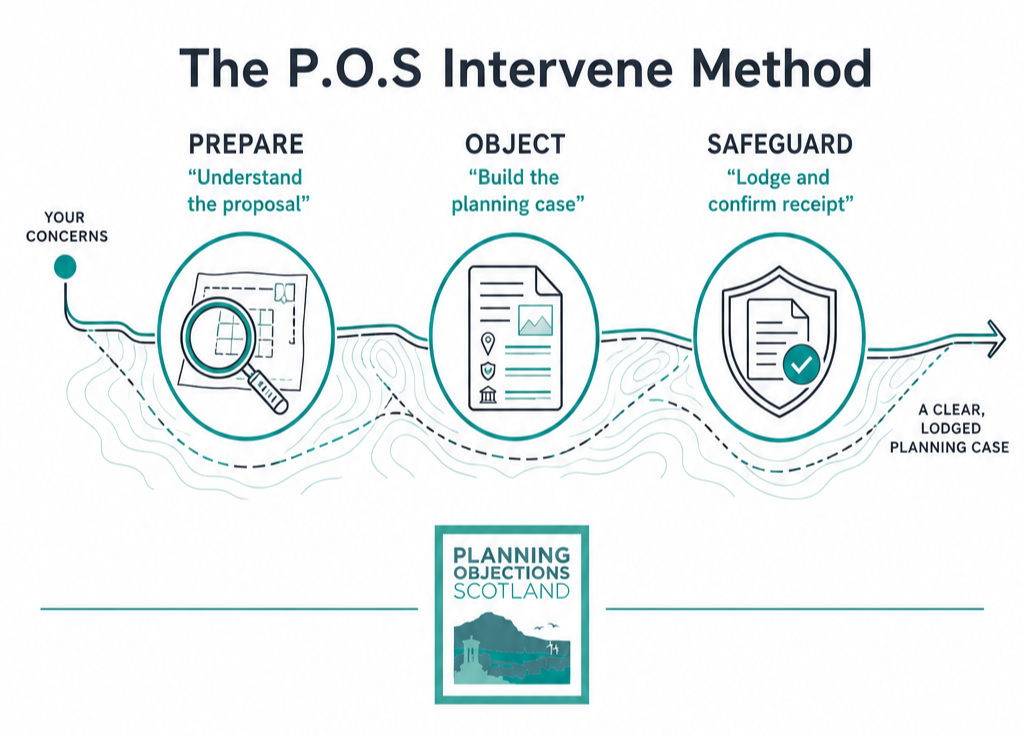
Every planning objection prepared by Planning Objections Scotland follows our P.O.S. Intervene Method—a structured process designed to ensure that every representation is evidence-led, policy-based and focused on material planning considerations rather than opinion.
Although every planning application raises different issues, our methodology provides a consistent framework for identifying the strongest planning arguments before they are presented to the planning authority.
Prepare
The commission began with confidential discussions with our clients to understand the proposal and identify the principal planning concerns.
Following agreement of the scope of work and fixed fee, we undertook a detailed review of the planning application, revised drawings, supporting documentation, planning history and the relevant planning policy framework.
Particular attention was given to the adequacy of the submitted plans, residential amenity, design quality, landscaping, biodiversity, drainage, parking provision and the overall relationship of the development with the surrounding residential area.
This review established the factual planning position before any planning conclusions were drawn.
Object
The commission began with confidential discussions with our clients to understand the proposal and identify the principal planning concerns.
Following agreement of the scope of work and fixed fee, we undertook a detailed review of the planning application, revised drawings, supporting documentation, planning history and the relevant planning policy framework.
Particular attention was given to the adequacy of the submitted plans, residential amenity, design quality, landscaping, biodiversity, drainage, parking provision and the overall relationship of the development with the surrounding residential area.
This review established the factual planning position before any planning conclusions were drawn.
Safeguard
Following client approval, the completed planning objection and supporting appendices were lodged with Highland Council.
Receipt was confirmed, ensuring the representations formed part of the formal planning record and were available to inform the planning authority’s determination of the application.
As further information was submitted by the applicant, the objection was reviewed and updated so that new plans and supporting material could also be assessed against the Development Plan.
The remainder of this case study explains how the P.O.S. Intervene Method was applied to this proposal.
Thorough Review of the Planning Application
Our review extended well beyond the submitted layout plans.
The planning application was assessed in its entirety, considering both the adequacy of the supporting information and the potential planning effects arising from the proposed residential development.
This included reviewing:
- the planning application and supporting documentation;
- revised plans and additional submissions;
- compliance with the Heads of Planning Scotland (HOPS) Validation Guidance;
- the submitted layout, elevations and site plans;
- neighbouring residential amenity;
- overlooking, privacy and outlook;
- design quality and placemaking;
- access, parking and internal circulation;
- drainage and infrastructure;
- biodiversity and landscaping;
- National Planning Framework 4;
- the Highland-wide Local Development Plan; and
- other relevant material planning considerations.
Our assessment identified a number of important planning concerns.
The planning submission continued to contain omissions and inconsistencies following the revised drawings, and questions remained regarding whether sufficient information had been provided to enable a comprehensive assessment. The objection also considered the relationship between the proposal and surrounding residential properties, together with the cumulative effects of the scale and layout of the development within its established setting.
Collectively, these matters required careful consideration before the planning authority could conclude that the proposal represented an acceptable form of development.
Turning Concerns into Planning Arguments
One of the most important aspects of any planning objection is translating understandable concerns into planning arguments capable of influencing the planning process.
In this case, the objection extended well beyond concerns about the number of flats proposed.
Instead, every issue was assessed against National Planning Framework 4, the Highland-wide Local Development Plan and other relevant planning guidance.
The objection considered whether the planning application contained sufficient information to enable meaningful public scrutiny and whether the proposal would deliver a high-quality place that respected neighbouring residential amenity, protected biodiversity, integrated successfully with its surroundings and complied with the statutory Development Plan.
Particular attention was also given to the quality of the submitted plans, revised information and supporting documentation. Validation issues, together with design quality, amenity, landscaping and infrastructure, formed important elements of the overall planning case.
Rather than presenting isolated concerns, the objection demonstrated how these matters collectively influenced the acceptability of the proposal and its compliance with planning policy.
This evidence-led approach ensured that the planning authority received a structured assessment founded upon planning policy rather than personal opinion.
The Outcome
Following detailed consideration of the planning application and the representations received, planning permission was refused.
While planning decisions always remain the responsibility of the planning authority, this case demonstrates the importance of professionally prepared planning objections founded upon planning policy, evidence and material planning considerations.
The objection identified significant issues relating to validation requirements, design quality, neighbouring amenity, biodiversity, infrastructure and the adequacy of the information submitted in support of the application.
It also demonstrates that relatively modest residential developments can require detailed technical scrutiny where they have the potential to affect existing communities and where the supporting information does not fully address the planning issues arising.
Could We Help You?
If you are concerned about a planning application affecting your home, neighbourhood or local environment, Planning Objections Scotland can provide an independent assessment of the proposal and prepare a professionally researched planning objection on your behalf.
Using our proven P.O.S. Intervene Method, we assess every planning application against the relevant national and local planning policies, identify the strongest material planning considerations and prepare evidence-led representations designed to assist planning authorities in reaching informed planning decisions.
Whether your concerns relate to residential developments, flats, housing proposals, neighbouring amenity, biodiversity or another form of development, we can help ensure your concerns are presented clearly, professionally and effectively.
If you are concerned about a planning application within the Highland Council area, contact Planning Objections Scotland to arrange a confidential review and discover how our professional planning objection service could help protect your interests.
 Confidential, no-obligation case review Reviewed by a professional planning consultant Know where you stand within 1 working day* Clear fixed fee before you decide to proceed Objection strategy based on planning policy — not emotion