
South Ayrshire Council Planning Objection Success
Description
Caravan Storage, Sales and Repair Proposal Withdrawn by South Ayrshire Council (2025)
Location
Outcome
Withdrawn
Introduction
Planning applications seeking to introduce commercial storage, sales and repair activities into rural or semi-rural locations can raise a wide range of planning issues. Although the reuse of previously developed land may sometimes be supported, the planning authority must still consider whether the nature, scale and intensity of the proposed use are appropriate for the site and its surroundings.
This case study examines how Planning Objections Scotland assisted a neighbouring resident by preparing a comprehensive planning objection to the proposed change of use of former plant nursery land within South Ayrshire. The application sought permission for the siting, storage, sale and repair of caravans but was subsequently withdrawn.
To protect client confidentiality, identifying details have been removed. However, the planning issues, methodology and outcome accurately reflect the work undertaken.
The Proposal
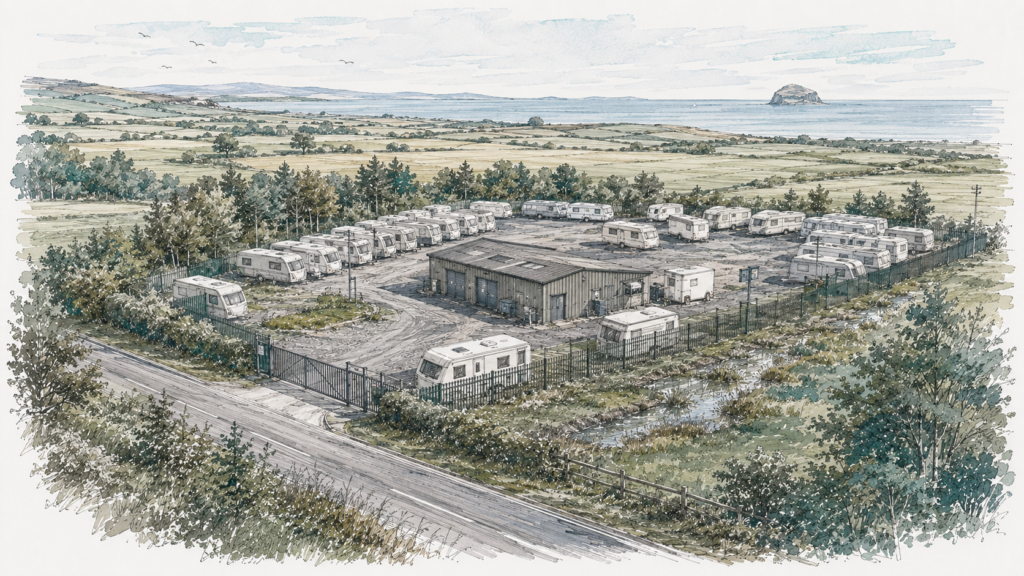
The application sought planning permission to change the use of land associated with a former plant nursery to allow caravans to be stored, displayed for sale and repaired.
The proposed use represented a substantial intensification of activity on the site. It had the potential to introduce extensive hardstanding, perimeter fencing, CCTV equipment, vehicle and caravan movements, commercial operations and associated servicing requirements into a rural and Green Belt setting.
The application description did not fully refer to several physical elements apparently required to facilitate the development, including fencing, CCTV infrastructure, hardstanding and a new vehicular access. The objection therefore considered not only the principle of the proposed use but also whether the application accurately and comprehensively described the development requiring permission.
The site also appeared to be susceptible to flooding and contained established trees and landscape features. Questions arose regarding drainage, ecological effects, access safety, visual impact and whether a commercial caravan operation could be appropriately accommodated in this location.
Given the scale and nature of the proposed activity, our client sought an independent assessment of whether the application complied with National Planning Framework 4, the South Ayrshire Local Development Plan 2 and other relevant material planning considerations.
Applying the P.O.S. Intervene Method
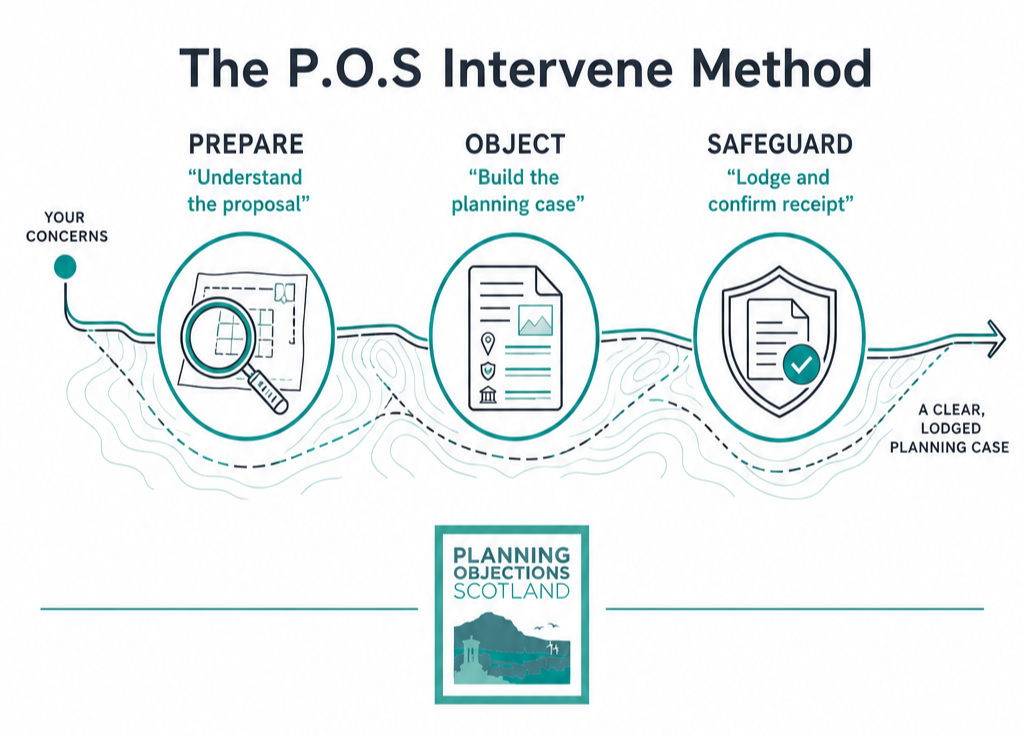
Every planning objection prepared by Planning Objections Scotland follows our P.O.S. Intervene Method—a structured process designed to ensure that every representation is evidence-led, policy-based and focused on material planning considerations rather than opinion.
Although every planning application raises different issues, our methodology provides a consistent framework for identifying the strongest planning arguments before they are presented to the planning authority.
Prepare
The process began with a confidential review of the planning application and an initial discussion with our client to understand the proposed development and identify the principal areas of concern.
Once the scope of the commission, fixed fee and programme had been agreed, we undertook a detailed review of the application drawings, application form, site circumstances, planning policy framework and supporting information.
Particular attention was given to whether the plans accurately showed the extent of the proposed development, access arrangements, site boundaries, hardstanding, fencing, drainage infrastructure and the different areas intended for caravan storage, sales and repair.
The rural and Green Belt location also required careful consideration of the site’s landscape character, flood risk, ecological value, transport accessibility and relationship with nearby residential properties.
Object
Having established the factual planning position, each concern was tested against the statutory Development Plan and other relevant planning guidance.
Rather than relying on general opposition to the proposed commercial use, the objection explained how the development could conflict with policies relating to Green Belt protection, rural development, sustainable transport, biodiversity, flood risk, water management, trees, landscape character, design quality and health and safety.
The representation also examined the technical adequacy of the submission against the Heads of Planning Scotland Validation Guidance. It identified missing or inadequate information that restricted the ability of the planning authority and neighbouring residents to understand and assess the full effects of the proposal.
A draft objection report was then provided to our client for review before being finalised.
Safeguard
Following client approval, the completed objection report and supporting appendices were submitted to South Ayrshire Council.
Receipt of the representation was confirmed, ensuring that the concerns formed part of the formal planning application record and could be considered during the determination process.
The objection expressly reserved our client’s ability to comment on any amended plans or additional information submitted later. This was particularly important because the application contained significant information gaps that could not appropriately be addressed without further public scrutiny.
As with every instruction, we remained available to provide additional professional support should the application progress through amendments, committee consideration or appeal.
The remainder of this case study explains how the P.O.S. Intervene Method was applied to this particular proposal.
Thorough Review of the Planning Application
Our review extended considerably beyond the principle of using the land for caravan storage.
The application was assessed in its entirety, considering both the quality of the submission and the potential effects of the proposed development on the surrounding area.
This included reviewing:
- the planning application form and development description;
- the submitted location and site plans;
- compliance with the Heads of Planning Scotland Validation Guidance;
- the accuracy and extent of the application boundary;
- access arrangements and visibility requirements;
- the proposed areas for caravan storage, sales and repair;
- hardstanding, fencing, gates and CCTV infrastructure;
- existing and proposed site levels;
- surface-water and foul-drainage arrangements;
- flood risk;
- biodiversity and protected species;
- existing trees, hedgerows and landscape features;
- Green Belt and rural development policies;
- landscape and visual impact;
- noise, air quality and operational disturbance;
- transport sustainability and road safety;
- National Planning Framework 4;
- the South Ayrshire Local Development Plan 2; and
- other relevant material planning considerations.
Our assessment identified extensive shortcomings in the planning submission.
No appropriately scaled block plan had been provided to show the detailed layout of the proposed development. The plans did not clearly distinguish the areas intended for caravan sales, storage and repair, nor did they adequately show hard and soft landscaping, boundary treatments, dimensions, access arrangements or the relationship between the development and the site boundaries.
The objection also identified concerns about the red-line boundary. The submitted material did not clearly demonstrate that all land required for the proposed access, visibility splays and drainage infrastructure was included within the application site. The application form stated that no new or altered access from a public road was required, despite the submitted plans appearing to indicate otherwise.
No adequate drainage strategy or Flood Risk Assessment had been provided, despite the apparent susceptibility of the site to fluvial flooding and the likelihood that extensive hardstanding would increase surface-water runoff. There was also no clear information explaining how foul drainage generated by staff or repair operations would be managed.
The submission contained no ecological appraisal or protected-species surveys, no comprehensive arboricultural assessment and no clear landscape or biodiversity enhancement proposals. It therefore failed to provide the information required to assess the potential loss or fragmentation of habitats and the effect on established trees and hedgerows.
Collectively, these omissions prevented a comprehensive and reliable assessment of the proposal.
Turning Concerns into Planning Arguments
One of the most important aspects of any planning objection is translating understandable concerns into planning arguments capable of influencing the planning process.
In this case, the objection extended well beyond concerns about noise, traffic or the visual appearance of stored caravans.
The site was located within the Green Belt, where development is subject to specific national and local policy tests. The proposed caravan storage, sales and repair operation did not fall within the limited categories of development ordinarily supported in the Green Belt, and no compelling justification had been provided to demonstrate why the use required this rural location rather than an allocated or established commercial site.
The proposed hardstanding, tall fencing, CCTV equipment and commercial activity also had the potential to introduce an urban and industrial character into the rural landscape. These physical and operational changes raised direct concerns under NPF4 policies relating to natural places, design, landscape quality, rural development and successful placemaking.
Transport was another material consideration. The proposed use would be inherently dependent on cars and towing vehicles. The objection highlighted the absence of adequate access drawings, visibility splays and road geometry information, together with concerns regarding restricted visibility, traffic speeds and the additional manoeuvring requirements associated with caravans.
Flood risk and drainage formed an important part of the planning case. The proposed creation of hard surfaces could reduce permeability and increase runoff, yet the application contained no Flood Risk Assessment, drainage strategy or Sustainable Drainage System proposals. This prevented the planning authority from establishing whether the development would be safe or whether it could increase flood risk elsewhere.
The objection also considered the lack of information about the proposed repair operation. Without details of the machinery, hours of operation, waste products, noise, emissions and scale of repair activities, it was not possible to determine whether the use would be compatible with neighbouring properties or human health and amenity.
Rather than presenting these matters as a collection of general concerns, each issue was connected to the relevant provisions of National Planning Framework 4, the South Ayrshire Local Development Plan 2 and supporting technical guidance.
This allowed the planning authority to consider the development against the statutory planning framework and understand why the missing information was material to the decision.
The Outcome
Following the submission of the planning objection, the application was withdrawn.
A withdrawal is a successful planning outcome because it prevents the application from progressing to approval in its submitted form. It may occur for several reasons, including recognition that significant amendments, additional technical evidence or an entirely new application would be required before the proposal could be properly assessed.
While the decision to withdraw always rests with the applicant, this case demonstrates the value of a professionally prepared objection that examines both the merits of a proposal and the adequacy of the planning submission.
The objection identified fundamental questions regarding the principle of development in the Green Belt, access safety, flood risk, drainage, biodiversity, landscape character, operational impacts and the completeness of the submitted plans.
It also demonstrated why applications involving apparently straightforward changes of use can require detailed scrutiny where the operational and physical consequences of the new use have not been fully explained.
Could We Help You?
If you are concerned about a planning application affecting your property, community or the surrounding rural environment, Planning Objections Scotland can provide an independent assessment of the proposal and prepare a professionally researched planning objection on your behalf.
Using our proven P.O.S. Intervene Method, we assess every application against the relevant planning policies, identify the strongest material planning considerations and prepare evidence-led representations designed to assist planning authorities in reaching informed decisions.
Whether the proposal involves caravan storage, a commercial change of use, Green Belt development, rural industry, housing or another form of development, we can help you understand your options and ensure your concerns are presented clearly, professionally and effectively.
If you are concerned about a planning application in South Ayrshire, contact Planning Objections Scotland to arrange a confidential review and discover how our professional planning objection service could help protect your interests
 Confidential, no-obligation case review Reviewed by a professional planning consultant Know where you stand within 1 working day* Clear fixed fee before you decide to proceed Objection strategy based on planning policy — not emotion