
South Lanarkshire Council Planning Objection Success
Description
Detached Dwellinghouse Refused by South Lanarkshire Council (September 2025)
Location
Outcome
Planning Permission Refused
Introduction
Applications for new homes within established residential areas are not automatically acceptable simply because they are located within the settlement boundary. Every proposal must demonstrate that it has been properly designed, integrates with its surroundings and complies with the statutory Development Plan. Equally important, planning applications must provide sufficient information to allow both the planning authority and neighbouring residents to fully understand the proposal and assess its likely impacts.
This case study explains how Planning Objections Scotland assisted neighbouring residents by preparing a comprehensive planning objection to a proposed detached dwellinghouse within South Lanarkshire. Following submission of the objection, the planning application was subsequently refused.
To protect client confidentiality, identifying details have been removed. However, the planning issues, methodology and outcome accurately reflect the work undertaken.
The Proposal
The application sought planning permission for the erection of a detached dwellinghouse with an attached double garage, retaining walls and associated external works on land within an established residential area of Hamilton.
Although the proposal related to a single dwelling, the site presented a number of technical planning challenges. The development involved substantial engineering operations, including changes to existing ground levels, retaining structures and the removal of established woodland. The proposal also occupied a constrained site adjoining existing residential properties, requiring careful consideration of privacy, daylight, outlook and the wider character of the surrounding neighbourhood.
Beyond the physical development itself, the planning submission raised questions regarding the adequacy of the supporting information. The application drawings, validation material and technical evidence required detailed scrutiny to determine whether the proposal could be properly assessed against National Planning Framework 4 (NPF4), the South Lanarkshire Local Development Plan 2 and other material planning considerations.
Our clients instructed Planning Objections Scotland to undertake an independent review of the planning application to determine whether the proposal complied with the statutory planning framework and whether all relevant planning issues had been fully addressed.

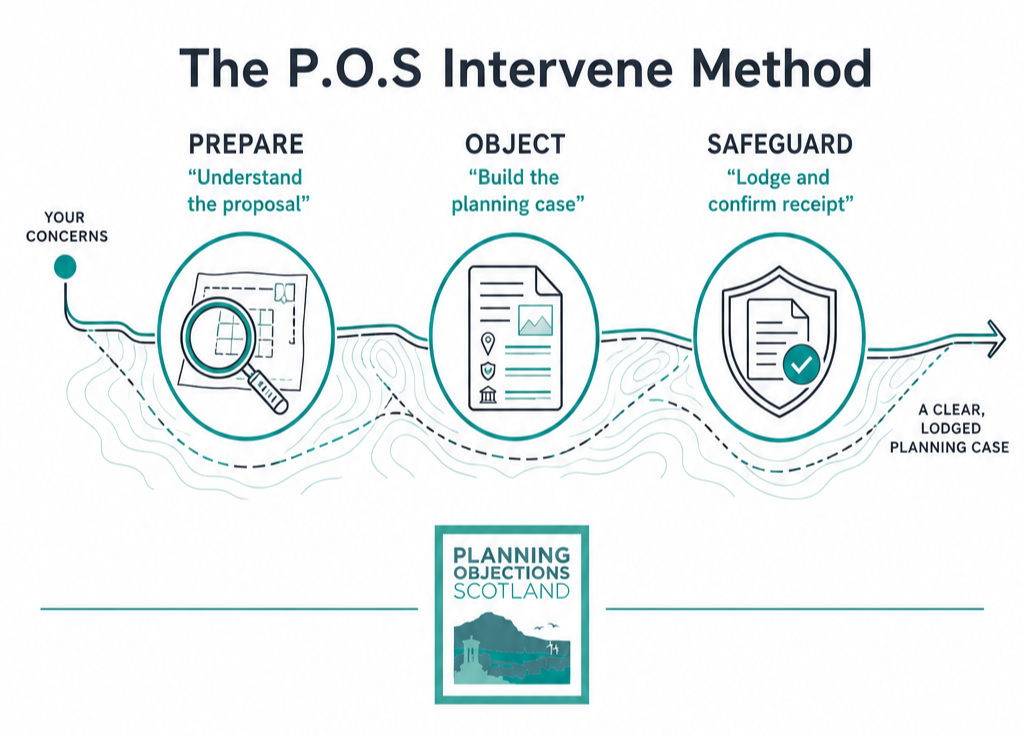
Applying the P.O.S. Intervene Method
Every planning objection prepared by Planning Objections Scotland follows our P.O.S. Intervene Method—a structured process designed to ensure that every representation is evidence-led, policy-based and focused on material planning considerations rather than opinion.
Although every planning application raises different issues, our methodology provides a consistent framework for identifying the strongest planning arguments before they are presented to the planning authority.
Prepare
The commission began with a confidential discussion with our clients to understand the proposal and identify the principal concerns arising from the development.
Following agreement of the scope of work and fixed fee, we undertook a detailed review of the planning application, supporting documentation, submitted drawings, planning history and the relevant planning policy framework.
Particular attention was given to the accuracy of the submitted plans, the extent of the application boundary, site levels, retaining structures, woodland impacts, drainage arrangements and the relationship between the proposed dwelling and neighbouring residential properties.
This initial review established the factual planning position before the proposal was assessed against planning policy.
Object
Once the technical review had been completed, each planning issue was considered against the statutory Development Plan and other relevant planning guidance.
Rather than relying upon general opposition to the proposed dwelling, the objection demonstrated where the application conflicted with National Planning Framework 4, the South Lanarkshire Local Development Plan 2, Heads of Planning Scotland (HOPS) Validation Guidance and other material planning considerations.
The representation examined not only the planning merits of the proposal but also whether the planning application itself contained sufficient information to allow a lawful and informed planning decision to be reached.
A draft objection report was provided to our clients before being finalised and submitted to South Lanarkshire Council.
Safeguard
Following client approval, the completed objection report and supporting appendices were submitted to the planning authority.
Receipt of the representation was confirmed, ensuring that the concerns became part of the formal planning record and were available for consideration during determination of the application.
The objection also expressly reserved our clients’ ability to comment upon any amended plans or additional information submitted during the application process, recognising that significant shortcomings existed within the original submission.
The remainder of this case study explains how the P.O.S. Intervene Method was applied to this particular planning application.
Thorough Review of the Planning Application
Our review extended considerably beyond the design of the proposed dwelling.
The application was examined in its entirety, considering both the quality of the submitted information and the potential planning impacts arising from the development.
This included reviewing:
- the planning application and supporting documents;
- compliance with the Heads of Planning Scotland Validation Guidance;
- the application description and application form;
- the submitted location, site and block plans;
- the accuracy of the red-line application boundary;
- land ownership certification;
- proposed access arrangements;
- site levels and engineering operations;
- retaining walls and ground stability;
- drainage and Sustainable Drainage Systems (SuDS);
- biodiversity and protected species;
- woodland removal and impacts upon the Ancient Woodland Inventory;
- neighbouring residential amenity;
- overlooking, privacy and overshadowing;
- National Planning Framework 4;
- the South Lanarkshire Local Development Plan 2; and
- other relevant material planning considerations.
Our assessment identified extensive shortcomings within the planning submission.
The application failed to satisfy numerous requirements contained within the Heads of Planning Scotland Validation Guidance. Deficiencies included incomplete location and block plans, insufficient dimensions, inadequate information regarding site levels, uncertainty surrounding access arrangements, incomplete drainage details and inconsistencies between the submitted drawings. These omissions significantly restricted the ability of both the planning authority and neighbouring residents to properly understand the proposal.
Turning Concerns into Planning Arguments
One of the most important aspects of any planning objection is translating understandable concerns into planning arguments capable of influencing the planning process.
In this case, the objection extended well beyond concerns about the appearance of the proposed house.
The representation first addressed whether the planning application had been validly submitted. By assessing the proposal against the Heads of Planning Scotland Validation Guidance, we identified significant omissions relating to plans, ownership certification, drainage information and site levels that prevented proper public scrutiny and informed decision-making.
The proposal was then assessed against National Planning Framework 4 and the South Lanarkshire Local Development Plan 2.
The objection examined the proposal’s effects on biodiversity, woodland, protected species and the wider green network, demonstrating potential conflicts with policies relating to climate change, natural places, forestry, biodiversity and blue-green infrastructure.
Residential amenity formed another significant planning issue. The proposed dwelling, elevated terraces and associated engineering works raised concerns regarding overlooking, loss of privacy, overshadowing, visual dominance and the relationship between the development and neighbouring properties.
Drainage and engineering design were also important considerations. The absence of a detailed drainage strategy, inadequate information regarding SuDS and uncertainty surrounding retaining structures prevented the planning authority from fully understanding the consequences of the proposed development.
Rather than presenting these matters as isolated concerns, each issue was linked directly to the relevant provisions of National Planning Framework 4, the South Lanarkshire Local Development Plan 2, supplementary planning guidance and established planning case law.
This evidence-led approach ensured that the planning authority was provided with a structured planning assessment founded upon policy, legislation and professional planning practice rather than personal opinion.
The Outcome
Following submission of the planning objection, South Lanarkshire Council refused planning permission.
A refusal represents a successful planning outcome because the planning authority has concluded that the proposal fails to satisfy the requirements of the Development Plan and that permission should not be granted in its submitted form.
While planning decisions always remain the responsibility of the planning authority, this case demonstrates the value of a professionally prepared objection that examines both the planning merits of the proposal and the adequacy of the information submitted in support of the application.
The objection identified significant concerns relating to validation requirements, biodiversity, woodland loss, neighbouring amenity, drainage, engineering works and compliance with National Planning Framework 4 and the South Lanarkshire Local Development Plan 2.
It also demonstrated why even proposals for a single dwellinghouse can require detailed scrutiny where they involve complex engineering operations, sensitive environmental assets and potentially significant impacts upon neighbouring properties.
Could We Help You?
If you are concerned about a planning application affecting your home, property or local community, Planning Objections Scotland can provide an independent assessment of the proposal and prepare a professionally researched planning objection on your behalf.
Using our proven P.O.S. Intervene Method, we assess every planning application against the relevant planning policies, identify the strongest material planning considerations and prepare evidence-led representations designed to assist planning authorities in reaching informed planning decisions.
Whether the proposal involves a new dwellinghouse, housing development, commercial development, rural development or another form of development, we can help ensure your concerns are presented clearly, professionally and effectively.
If you are concerned about a planning application within South Lanarkshire, contact Planning Objections Scotland to arrange a confidential review and discover how our professional planning objection service could help protect your interests.
 Confidential Review No obligation Clear fixed fee before any work starts *Response within 1 working day